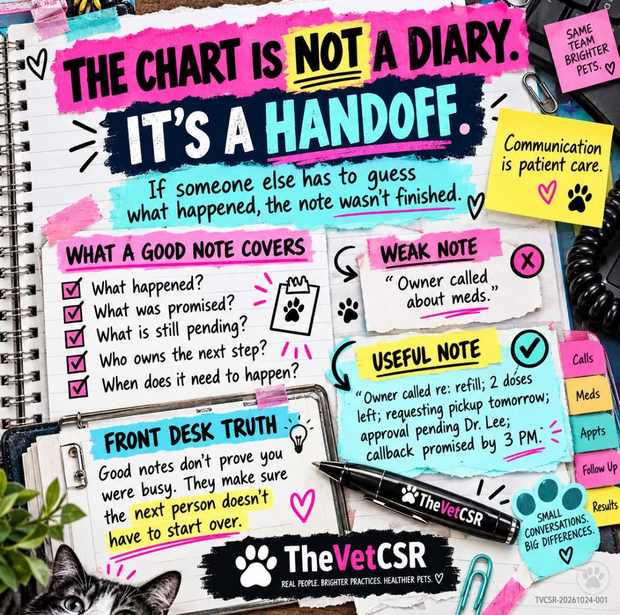
 TheVetCSR
Training System: first lesson free
The cover plus the first full lesson of the Front Desk Training System, Set the tone early (Module 1, The Phones), exactly as it prints in the full 20-lesson system.
Download the free sampleMONDAY, OCTOBER 27
Good morning, front desk.

The Shop / Training tools for the front desk
Guides, word-for-word call scripts, posters, and workbooks, written at a real desk and sold on Etsy. New this week: the Front Desk Training System, the 20 phone script lessons your new hire can actually train from.
Start free. Two downloads, no email gate, no strings: print them, keep them by the phone, and see how the words land at your desk.
The cover plus the first full lesson of the Front Desk Training System, Set the tone early (Module 1, The Phones), exactly as it prints in the full 20-lesson system.
Download the free sampleOne printable card from the Phone Script Cards set, word for word: the boundary line for the caller who starts sharp, plus what to avoid and the next step.
Download Card 01 freeTap what is true, not what sounds productive.
Veterinary Receptionists Are Underestimated
I stopped being offended when prospective employers or former hospitals referred to my role in the veterinary industry as “receptionist.”
At first, I used to think, What is this, 1960? I had never really researched my role or even the meaning behind the word receptionist. The title I once disliked actually does carry weight. But in veterinary medicine, it still falls far short of describing what the job truly is.
A standard receptionist job description usually sounds simple enough: answer questions, greet visitors, direct calls, schedule appointments, sort paperwork, and manage phones. On paper, it can look like an entry-level role. In reality, veterinary reception is anything but entry-level.
I’ve worked in the veterinary industry since 2013 under titles like Client Service Representative and Client Service Assistant. The titles changed, but the core duties never really did. And while many of those duties technically fit under the broad label of “receptionist,” that title only covers the surface of what the job actually demands.
To be a veterinary receptionist, you need working knowledge of veterinary medicine, whether you learned it in school, from coworkers, or through hands-on experience. Medical knowledge matters. Communication matters. You have to take a doctor’s rushed explanation, or sometimes barely legible handwriting, and turn it into something a client can actually understand. You are the link between the front and the back of the hospital. You are the first person clients see when they walk in, the first person they call when they are worried, and often the last person they see before they leave.
For a long time, I asked myself: Am I really just a receptionist? Yes, I answer phones, sometimes six lines at once. I check clients in and out, often while handling multiple calls, managing anxious pets, listening to a question a doctor throws at me in passing, and sending records or lab results to another clinic. I handle emails, voicemails, scheduling issues, upset clients, and everything in between. That is the bare minimum. And even that “bare minimum” requires far more skill than most people realize.
What people do not see is everything else veterinary receptionists are expected to do.
We assess emergencies, which means we have to recognize an emergency when we hear one. We listen carefully to what a client is saying and decide whether a pet needs immediate care or whether it can safely wait. We calm people down when they are crying, panicking, or overwhelmed, because being a pet owner can be terrifying. We know medications, vaccines, preventives, common symptoms, and basic care guidance. We explain processes, clarify instructions, and help clients make sense of what is happening with their animal.
We are translators in every sense of the word. We translate medical language into everyday language. We translate stress into reassurance. We translate urgency into action.
We translate stress into reassurance. We translate urgency into action.
From the essay
I did not understand all the big veterinary terms when I first started, either. I learned them. And now I can turn that information into something another person can understand in the middle of one of the most emotional moments of their day.
Within seconds of someone walking through the door, I am already reading them and adjusting how I communicate. I am paying attention to tone, body language, urgency, confusion, grief, frustration, or fear. I look for a way to connect, not to become someone’s best friend and not to sell them something, but to make sure they trust me enough to hear me. Because if they understand me, they are more likely to understand what is happening with their pet.
And that matters.
Because in the end, both the client and I are there for the same reason: the animal.
None of that shows up in a typical receptionist job description.
The description does not mention staying late for surgery pickup or making sure that after a $20,000 day, the cash drawer balances perfectly. It does not mention coming in early to prepare paperwork, staying late because the last appointment ran two hours over, or helping clean when the hospital is short-staffed. It does not mention skipped lunches, emotional exhaustion, or being the first person blamed when something goes wrong.
It definitely does not mention helping guide someone through euthanasia.
From the essay
It does not say that you may be the person who walks a client through the process from beginning to end, while holding back your own emotions so they can have space for theirs. It does not say that you may help make a paw print for a family saying goodbye to their pet. It does not say that in some hospitals, you may even end up helping restrain a fractious cat because there simply is not enough staff.
Being a veterinary receptionist does not fully prepare you for what the job becomes. You learn by doing. You learn by adapting. You learn by carrying the emotional and operational weight of the front desk every single day.
And no, it is not simply a stepping stone to becoming a technician. That is a different profession. Being a veterinary receptionist is its own career. It requires emotional intelligence, medical awareness, communication skills, financial accuracy, crisis management, and resilience. In many ways, it is one of the most underestimated roles in veterinary medicine.
So why do veterinary hospitals struggle to keep good receptionists?
Because too often, they treat and pay us like basic receptionists when we are doing far more than basic reception work.
Hospitals say they want strong front-desk staff, but many still hire for the role as if it requires little more than friendliness and a pulse. If the pay is entry-level, the applicant pool will reflect that. Yes, people can be trained, and yes, good people can grow into the role. But veterinary hospitals make serious mistakes when they underestimate how much knowledge, judgment, and emotional stamina the position actually requires.
Too often, hiring managers choose candidates based on surface-level traits instead of true fit for the demands of veterinary medicine. They may see a polished résumé, a little pet-sitting experience, or a general love of animals and assume that is enough. It is not.
I do not know many medical professionals who would hire clinical staff with no relevant background and expect everything to work out. Yet I have seen veterinary hospitals repeatedly hire inexperienced client service staff into roles that require real medical communication skills and real pressure management from day one.
That is one reason hospitals lose good receptionists so easily. Passion alone does not retain people. Being underpaid, underestimated, and emotionally drained drives them out.
Veterinary receptionists are not “just receptionists.” We are communicators, coordinators, translators, problem-solvers, and emotional shock absorbers. We help hold hospitals together in ways that are often invisible until we are gone.
We help hold hospitals together in ways that are often invisible until we are gone.
From the essay
It is time the role was treated that way.
Keep going
 Training guides, call scripts, posters, and workbooks for the front desk, in the Etsy shop.
Visit the shop
05CommunityLive
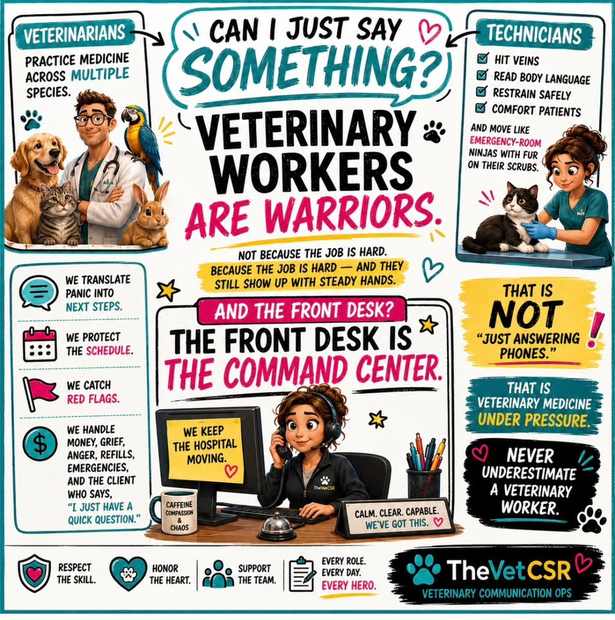 The Facebook community: daily posts, the Monday VETMED Update, and subscriber extras.
Join the community
06ListenLive
 The Veterinary Receptionst Podcast: daily scenarios, scripts, and vet med news.
Hear the show
07BlogLive
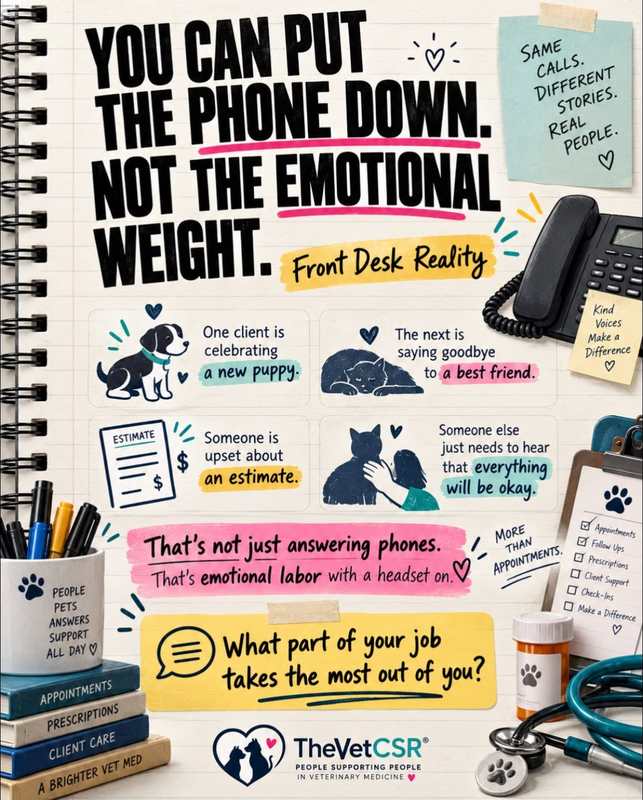 The archive: essays, scripts, and front-desk thinking, in long form.
Read the blog
08About
Who Em is, why this exists, and the rescue mission it all funds.
Meet Em
The posts this community shared most, and what each one proved.