 TheVetCSR
Blog / Front Desk Playbook
The Waitlist, Done Honestly: A Front Desk System That Keeps Promises
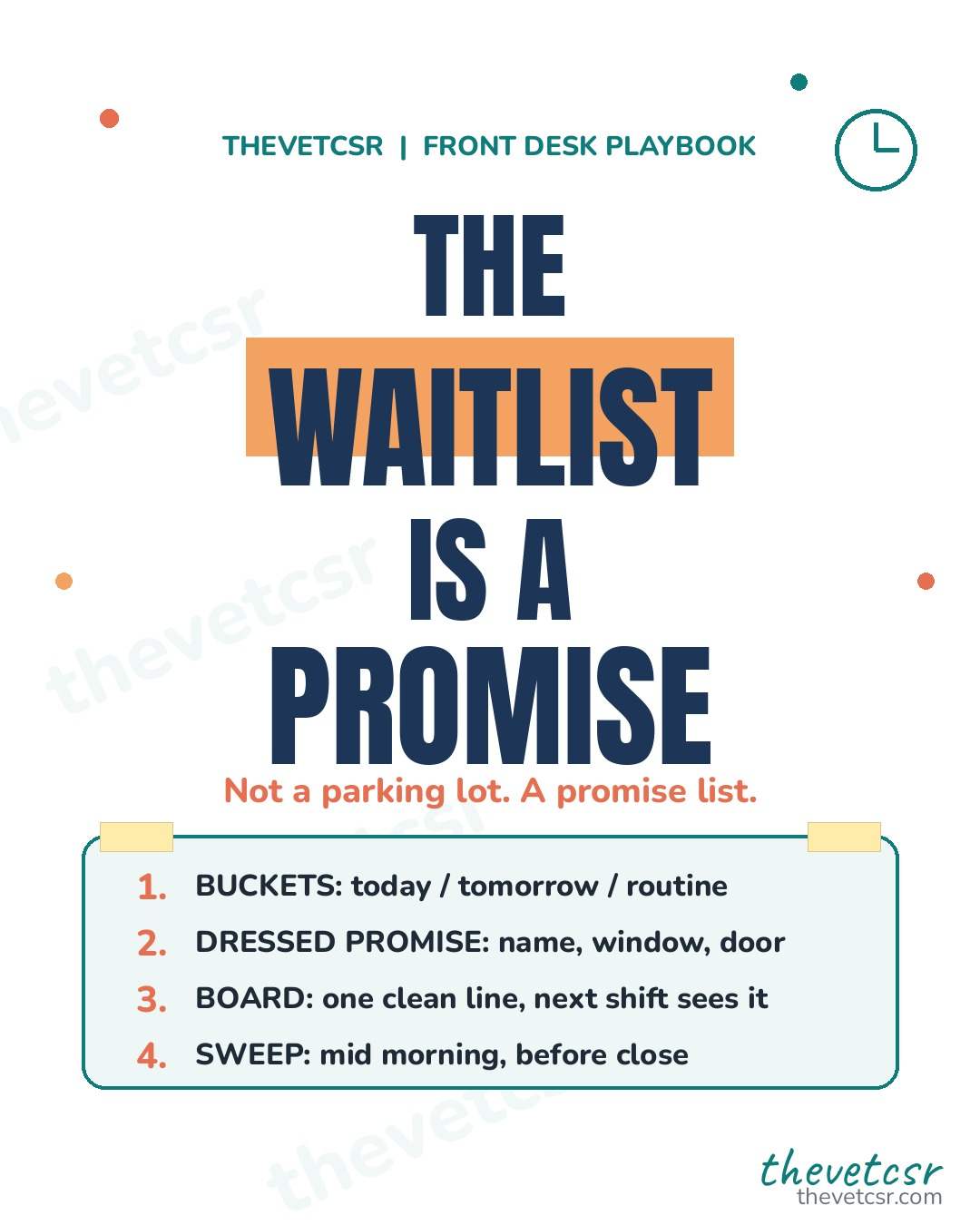
The schedule is full and the caller needs to be seen soon. Three buckets, the dressed promise, the board, the twice daily sweep, and the door back in. A waitlist is a promise list, not a parking lot.
The schedule is full. The caller needs to be seen soon. And the easiest sentence in the world is right there on your tongue: "I will put you on the waitlist and call you if something opens up."
Do not say it that way. That sentence is not a system. It is a parking lot with a polite name, and the client can tell the difference by noon the next day, when no one has called.
This playbook comes from the October 26 episode of TheVetCSR Daily, the waitlist deep dive, blown up into the full desk system: three buckets, the dressed promise, the board, the twice daily sweep, the door back in, and the angry callback branch. Same system, written down so the next shift can run it without you.
Why most waitlists fail (and it is not the team)
A waitlist usually dies in one of three places. The name lives on a sticky note, and the sticky note falls off. The name lives in one person's head, and that person goes home. Or the name lives on a list nobody owns, so nobody sweeps it, and nobody calls.
Notice what is missing from all three. Nobody was lazy. The system had no board, no owner, and no sweep. Fix the board, not the team. That is the manager version of this whole post, and it is also the kindest version, because a team cannot keep a promise a system never wrote down.
Here is the other truth underneath it. Most clients do not get angry about waiting. They get angry about being forgotten. A client who gets the call at ten, even if the call is "I am sorry, nothing opened up yet, here is tomorrow's plan," is a client who trusts you. A client who hears nothing all day does not.
The four parts, in order
A real waitlist has four parts. If you are missing any one of them, it is not a waitlist. It is a wish.
Part 1: The buckets
Not every waitlist caller is the same, and treating them the same is how urgent things get missed. Sort every caller into one of three buckets, in your head, on the call.
- Bucket one: today. Something that sounds urgent, something the team needs to hear about right now. Do not just write it down. Walk it to the team right now. The bucket is decided by what you hear, and confirmed by the team, never by you alone.
- Bucket two: tomorrow, or soon. Needs to be seen soon, but the team gets to confirm how soon. Your job is a great history, written down cleanly, carried to the team with a question, not a diagnosis. Here is what the owner is seeing, here is when it started, here is what they have tried. What do you want me to tell them?
- Bucket three: routine. The wellness visit, the nail trim, the recheck that is not urgent. That caller is not really on a waitlist at all. They are booking the next available appointment. Say so, kindly, because calling regular booking a waitlist confuses everybody, including the caller, who will sit by the phone waiting for a call that was never the plan.
A made up example, from the episode, so this is concrete. Mrs. Bennett calls about her dog Waffles. Waffles has been shaking his head and scratching at one ear since yesterday. He is eating, drinking, playing, and sleeping fine. Ear stuff hurts, and it matters, but it is not the same as a dog who cannot keep water down. Mrs. Bennett is probably bucket two. The team confirms that, not you. Your job is the history and the question.
That bucket thinking lines up with how scheduling guides talk about the book. Veterinary Practice News, in Wendy S. Myers' scheduling piece, puts it plainly: sick pets should be seen the same day, while preventive care can be seen within a week, and the book holds together when sick visits are sandwiched between predictable preventive visits instead of stacked on top of each other. Your three buckets are that same idea, in front desk language, applied to one caller at a time.
Part 2: The dressed promise
A waitlist promise is not "we will call you if something opens up." That is a promise with no shape. A real promise has three parts: a name, a window, and a door back in.
"Mrs. Bennett, I am putting you first on our list for tomorrow morning. I will call you by ten o'clock either way, even if nothing opens up, so you are not waiting by the phone wondering. And if Waffles gets worse tonight, here is what to do, and here is the emergency clinic number, just in case."
Name: first on the list for tomorrow morning. Window: by ten o'clock, either way. Door back in: what to do tonight, and the emergency number, without needing to call you back for permission.
The "either way" is the whole trick. It turns the callback from a maybe into a certainty. The client stops wondering whether they were forgotten, because you told them exactly when they will hear from you, even if the news is "nothing yet."
Part 3: The board
A waitlist that lives in your head is not a waitlist. It lives on paper, or on the board, where the next shift can see it. One line per caller. Name, pet, what is going on in the owner's own words, which bucket, what you promised, and by when.
The rule is simple, and it is worth saying out loud in your clinic: if it is not on the board, it did not happen. At the end of the day, somebody owns the board. Not everybody. Somebody. A board owned by everybody is a board owned by nobody, and that is how Mrs. Bennett's name spends two days on a sticky note nobody can find.
Use this line shape, every time:
Name | Pet | What, in their words | Bucket | Promise | Call by
Bennett | Waffles, ear shaking/scratching since yesterday, eating/playing fine | 2 | First tomorrow AM, call by 10 either way | 10:00 AM
That is the whole board. Nothing fancy, nothing missing, and the next shift can read it cold.
Part 4: The sweep, twice a day
Twice a day, once mid morning and once before close, somebody looks at the board and asks three questions. Who got in? Who is still waiting? Who did we promise a call by a certain time, and did we make it?
The sweep is the difference between a clinic that says it has a waitlist and a clinic that actually has one. Put it in the shift, not on top of the shift. Mid morning, before close, three questions, every day. A sweep that only happens "if someone has time" is not a sweep. It is a hope.
This is also where cancellations stop being lost revenue and start being the waitlist working. When a slot opens, the board tells you who is next, in bucket order, with a phone number and a promise time already attached. You are not hunting through sticky notes. You are calling the first name in bucket two. Practitioner guides on keeping a schedule full say the same thing in plainer business language: maintain a waitlist, and when a slot opens, reach out fast, because speed is what turns a cancellation into a filled appointment instead of an empty room.
The door back in: every waitlist conversation needs one
Every waitlist conversation needs an emergency door, because sometimes bucket two turns into bucket one overnight, and the client needs to know what to do without calling you back for permission.
Give it in plain words, on every waitlist call, even the calm ones. What counts as "worse" in the owner's own language, what to do if it happens, and the emergency clinic number if you are closed. Then write down that you gave it. A door you mentioned but never wrote down is a door the next shift cannot see.
This is also the line that protects the client from the most dangerous waitlist sentence of all: "he seems fine, so we will wait." Fine right now is not cleared. The door back in is what makes waiting safe enough to do honestly.
The honest no: never use a waitlist to avoid saying no
Never use a waitlist as a way to avoid saying no. If you are booked for two weeks and the pet needs to be seen this week, the honest answer might be that you cannot get them in soon enough, with a real recommendation attached.
"I do not want to put you on a list that will not get you seen this week, because that would not be fair to you or to Waffles. Here is what I recommend instead, and here is the next step I can help you with right now."
That is not losing a client. That is respecting them. A client who is told the truth, with a real next step, comes back. A client who waits two weeks for a call that never comes does not.
The recommendation itself belongs to the team, not to you. Your part is refusing to hide behind the word "waitlist" when the truth is "we cannot help soon enough." Ask the team what the next step should be, then say it plainly, on this call, while the client can still act on it.
What to say, word for word
The honest full day opener
"I want to be straight with you: today is fully booked, and I do not want to guess at a time I cannot keep. Can I take down exactly what is going on, put you on our list for tomorrow morning, and call you by ten either way?"
Straight, then specific, then a question. The caller gets honesty first, which is what earns permission for the rest of the call.
The history questions (a waitlist call is still an intake call)
- "What are you seeing, in your own words?"
- "When did it start?"
- "Has anything changed since it started?"
- "Is he eating and drinking normally?"
- "What worries you most about this?"
That last question is the one people forget, and it is the one that tells you what the caller will actually lose sleep over. Write the answer down in their words. It belongs on the board line, because it is what the team needs to hear first when they read the note.
The nothing opened up callback
"Hi, this is [name] from [clinic], calling like I promised, by ten. I am sorry, nothing has opened up for today yet. Here is tomorrow's plan, and here is what to do tonight if anything changes. You are still first on the list, and I will call you again by [time] tomorrow."
Make this call even when you have nothing to offer. Especially when you have nothing to offer. This is the call that proves the waitlist is a promise list. Skip it once, and every future promise you make sounds thinner.
The truthful cannot help soon enough line
"I do not want to leave you waiting on a list that will not get you in soon enough. Let me check with the team on the best next step for you, and I will call you back by [time] with exactly that."
Note the shape: no false hope, a team check, and a new promise with a time on it. You replaced a bad promise with a good one, on the same call.
What the front desk never says on a waitlist call
- Never "We will definitely get you in today," when you do not know that. A guarantee you cannot keep is worse than a wait, because it turns a delay into a broken promise.
- Never "It is probably nothing." That is a diagnosis in a friendly voice, and it is not yours to give. Report what the owner sees. Let the team decide what it means.
- Never "Just call back tomorrow," with no name, no note, no promise. That is not a waitlist. That is a dismissal with a smile on it.
- Never "There is nothing we can do." There is almost always something. A note, a team question, a next step, an emergency door. Find the something, and say it.
The angry callback branch: sorry first, fix on this call, audit after
It happens every week. The waitlist caller calls back, upset. They waited, nobody called, and now they are on the phone with you. They are not wrong to be upset. Start there.
"You are right, and I am sorry. You were promised a call by ten, and you did not get one. That is on us. Let me fix this on this call: here is where you stand right now, and here is exactly what happens next."
Sorry first, not explanation first. Fix on this call, not "someone will look into it." Then, after you hang up, write down what broke. Was the name never on the board? Was it on the board but nobody owned the sweep? Was the promised time impossible from the start?
An angry callback is not just a hard call. It is a free audit of your system. Use it. The answer to "what broke" is the next fix to the board, and the next fix is what stops the same call next week.
For practice managers: own the board, sweep the board
A waitlist with no owner is just a pile of sticky notes. Pick one person per shift who owns the board, and make the sweep part of the shift, not a favor somebody does if they have time. Mid morning, before close, three questions. Who got in, who is still waiting, whose promised call is due.
If your team keeps losing waitlist names, do not blame the team. Blame the board, and fix the board. Somewhere visible, one clean line per caller, where the next shift can actually see it. That is the whole management intervention, and it costs nothing but a decision.
One more manager note, from the scheduling side. When a client waits in the lobby, the dvm360 wait time guidance is blunt: keep clients informed with updates, because clients accept that a clinic runs behind, but they do not accept being left uninformed. The waitlist is the phone version of the same rule. The update is the service. The call by ten, even with no opening, is the lobby update, delivered before the client has to ask for it.
Start tomorrow with one rescued name
You do not need a new system to start. Look at your clinic's board, notebook, or wherever waitlist names live right now. Is there one name on it that has been sitting there too long, with no plan and no call? That name is your first sweep tomorrow. Call them, even if the news is "nothing yet, here is the plan." Rescue one name, and you have already run the system once, end to end.
Then, on your next full day, give every waitlist caller a dressed promise. Name, window, door back in. And make the call even when nothing opened up. That one habit alone will change how clients talk about your clinic, because clients talk about being remembered far longer than they talk about being booked.
The takeaway
A waitlist is a promise list, not a parking lot. Buckets, dressed promises, the board, the sweep, and the door back in, every single time. If a name is on it, somebody owns it, and somebody calls by the time they promised. That is the whole system, and it fits on an index card. Tape it to the board if you have to. Then run it twice a day, and let the clients find out, one on time callback at a time, that your clinic keeps its word.
Keep this system on your desk
If waitlist calls are the ones that unravel your team's day, the word for word scripts live in the Phone Script Cards on the TheVetCSR Etsy shop, and the full new hire phone training, including the hard calls, is in the Training Guide and Call Scripts. Both are printable, both are written for the desk, not the textbook.
More front desk playbooks live on the blog: thevetcsr.com/blog, with earlier posts in the archive at thevetcsr.blogspot.com. Listen to the episode this post is built from on the TheVetCSR podcast, watch on YouTube, and follow the page at facebook.com/thevetcsr. The shop is at thevetcsr.etsy.com.
Sources
- TheVetCSR Daily, October 26, 2026 episode, "The waitlist, done honestly" deep dive and "What Do I Actually Say" scripts (Mrs. Bennett and Waffles are fictional teaching examples from the episode; buckets, dressed promise, board, sweep, and door back in are TheVetCSR originals).
- Veterinary Practice News, Wendy S. Myers, "How to Avoid Scheduling Mistakes Every Veterinary Clinic Makes" (sick pets seen same day, preventive care within a week, alternating sick and preventive visits so the book holds together): veterinarypracticenews.com
- dvm360, "Monitor your clients' wait time" (keep clients informed with updates when the clinic runs behind; clients accept delays, not silence): dvm360.com
- Otto.vet, "Filling Appointments: Keeping Your Schedule Full Without Burning Out Your Team" (maintain a waitlist, reach out fast when a slot opens, turn cancellations into filled appointments): otto.vet
Scope note: this is a front desk communication playbook, not medical advice. The CSR's job is to sort what they hear, take a clean history in the owner's words, document it where the next shift can see it, and escalate to the veterinary team. Triage decisions, diagnoses, and treatment plans belong to the veterinarian, and your clinic's written protocols always win.