 TheVetCSR
Blog / Front Desk Playbook
The Dog Ate the Halloween Candy: The Front Desk Playbook for the Candy Call
A panicked owner, a whole bag of Halloween candy, and a dog who will not wait. Calm first, four questions in order, the xylitol branch, the never-says, and the chart note.
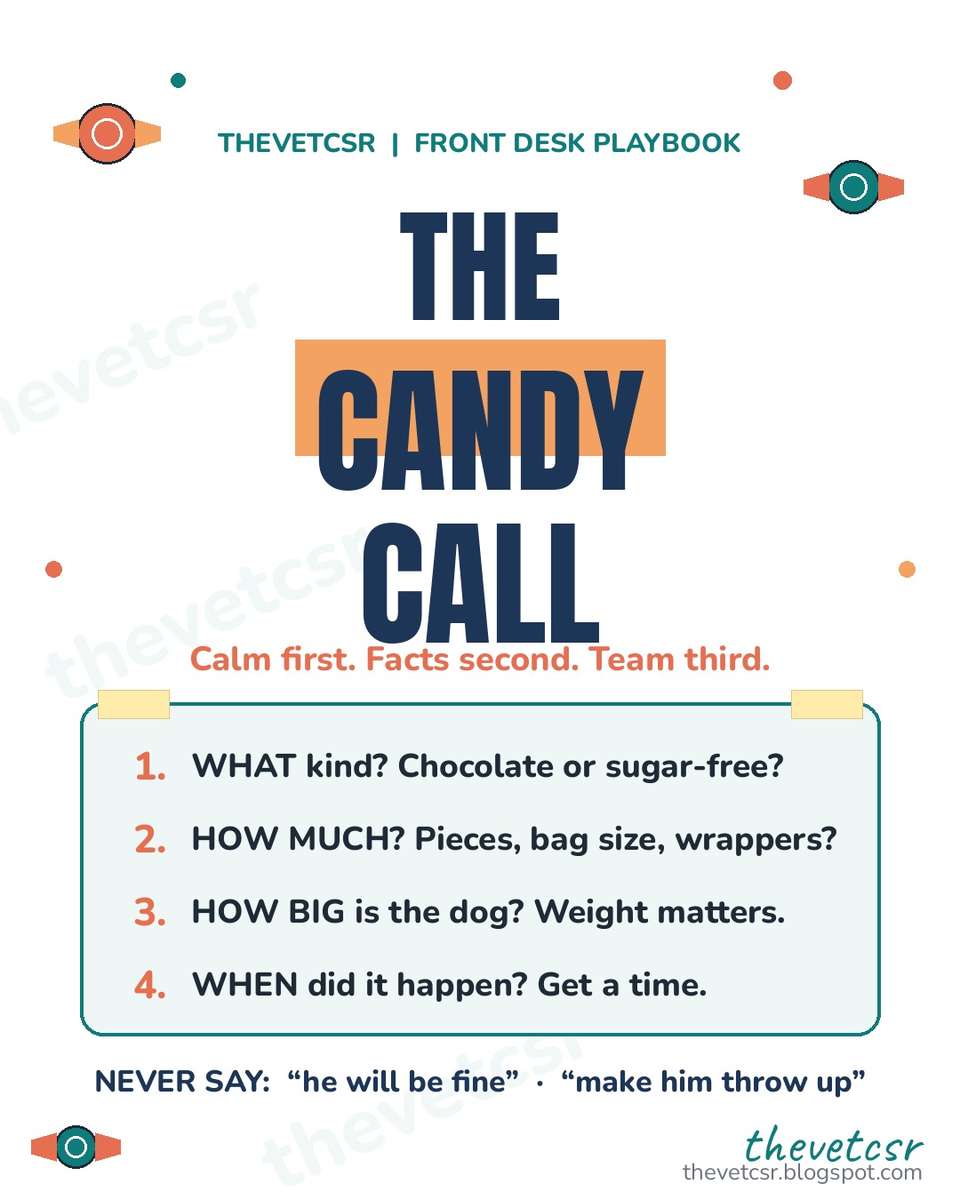
The phone rings and the voice on the other end is already out of breath. "My dog just ate the whole bag of Halloween candy. The whole bag. What do I do?"
This is the call Halloween week is made of. It will come in more than once, it will come in fast, and the person calling will be scared, embarrassed, or both. Your job is not to do the medicine. Your job is to calm the human, get the facts in the right order, and get that note to your team before the caller hangs up.
This playbook comes from the October 25 episode of TheVetCSR Daily, the Halloween candy call with Danielle and her golden retriever Copper, who ate a whole bag of Halloween candy. Same call, blown up into the full desk system: the opener, the four questions in order, the two branches that change everything, the never-says, and the chart note.
First: calm the caller before you collect anything
A panicked caller cannot answer good questions. Slow them down first. Say it like this:
"I am going to help you. Take a breath with me. We are going to figure this out together."
Then stay in charge of the pace. One question at a time. No rushing, no interrupting, no finishing their sentences. The calmer you sound, the calmer they get. That is not a soft skill. That is the skill.
The four questions, in this order
Do not improvise the order. The order is the system. Every answer changes what the team needs to know next.
1. What kind of candy?
This is question one for a reason. Chocolate and sugar-free candy are two different emergencies wearing the same bag.
Ask for the exact kind. Milk chocolate, dark chocolate, baking chocolate, cocoa powder, gummies, sugar-free anything. If it is sugar-free, ask them to read the ingredient label out loud. You are listening for one word: xylitol. It also hides under the name birch sugar.
Why it matters: chocolate contains theobromine and caffeine, stimulants dogs break down far more slowly than people do. The darker the chocolate, the more of those compounds it carries, so it takes less dark chocolate to become a problem. Xylitol is a separate danger entirely. The FDA warns that xylitol triggers a rapid insulin release in dogs, dropping blood sugar fast, sometimes within 10 to 60 minutes, and it can also damage the liver. A sugar-free label turns a chocolate call into a race.
2. How much?
"The whole bag" is not an amount. Get closer. How many pieces, roughly? What size bag? Was it full when the dog got it, or half gone already? A whole fun-size bag and a whole Costco bag are different calls, and the team needs to know which one they are walking into.
3. How big is the dog?
Amount means nothing without weight. A 70 pound golden and a 9 pound dachshund eating the same bag are not the same call. Ask for the dog's weight, or at least breed and size if the owner does not know the number. Smaller dog, same candy, bigger problem. Say that plainly if the caller needs to hear why you are asking.
4. When did it happen?
Five minutes ago and three hours ago are different calls. Timing decides urgency, and it decides what the team can still do. Get a time, not a vibe. "Just now" is fine. "Sometime this afternoon" needs narrowing.
Write down their exact words, not your interpretation of their words. "Ate the whole bag of mixed Halloween candy, mostly chocolate, about 20 minutes ago" is a note. "Ate candy" is not.
The wrapper question: ask it every time
Candy comes in wrappers, and wrappers go down with the candy. Ask: did the dog eat wrappers too? How many? What kind?
In the episode, Copper's wrappers were gold. That detail went in the note, because wrappers can cause their own problem on top of the candy, and the team needs to know what to watch for. Gold wrappers, foil, plastic, all of it goes in the note. Do not decide it does not matter. That is the team's call, not yours.
The two branches that change the call
Branch one: the dog already vomited
Do not cheer and do not relax. Write down exactly what the caller saw, in their words. What came up, how much, when. Then hand it to the team the same as any other candy call. Vomiting does not close the case. The team decides what it means.
Branch two: a kid gave the dog the candy
This one needs a soft voice. The adult on the phone is often already furious at the kid, or the kid is standing right there listening. Say it out loud:
"Nobody is in trouble here. We just need to help the dog."
Then go right back to the four questions. Shame slows the facts down, and slow facts are the one thing this call cannot afford.
The sugar-free branch: when xylitol is in the bag
If any of the candy is sugar-free, say so to the team immediately, in your first sentence, not your last. Do not wait for symptoms. The FDA's own guidance is blunt on this: if you think your dog has eaten xylitol, get to a vet or emergency animal hospital right away, because serious effects may not show for up to 12 to 24 hours and the dog may need monitoring.
Signs the team will ask about, and you can note if the caller reports them: vomiting, weakness, staggering, loss of coordination, collapse, seizures. Your job is to report them, not to interpret them. A dog who looks fine right now is not cleared. That sentence matters, because "he seems fine" is the sentence that makes people wait, and waiting is the mistake.
The chocolate branch: what the team is weighing
For the chocolate side of the bag, the Washington State University veterinary hospital lays out the shape of it: the darker and more concentrated the chocolate, the greater the risk, with cocoa powder and unsweetened baking chocolate at the top and milk chocolate lower but still dangerous in large amounts. Signs can show up 6 to 12 hours after eating, and they run from vomiting and restlessness to abnormal heart rhythms and seizures in severe cases. Theobromine hangs around in a dog's body far longer than in a person's, roughly a 17 hour half-life, which is why the team does not shrug this off.
You do not need to quote any of that to the caller. You need to know why the team takes the call seriously, so you take the call seriously.
What the front desk never says on a candy call
- Never "He will be fine." You do not know that, and the caller will hear it as a promise. If the dog is not fine, that sentence is the one they remember.
- Never tell them to induce vomiting at home. That is a medical direction, and it is not yours to give. Home methods can cause real harm. The team decides, and they decide with the facts you collected.
- Never "That is not that much chocolate." You are not the chocolate calculator. Amount plus type plus dog size plus timing is the team's math, not yours.
- Never "Just watch him and call back if he gets worse." That is a medical plan dressed up as a brush-off. Your close is a real next step with a time on it.
Close with a real next step and a time on it
Every candy call ends the same way: a concrete next step, with a time attached. Not "we will call you." Not "someone will get back to you." Say what happens next and when:
"I have your note with the team right now. We will call you back by [time] with what they want to do. If anything changes before then, if he vomits, gets wobbly, or seems off, call us straight back."
Then do the part that actually makes the promise true. Walk the note to the team immediately. Do not park it in a pile. Do not let it wait for the next lull. A candy call note is a walk-it-over note, every time.
The chart note, while it is fresh
Write the note before you take the next call. Fresh notes are accurate notes. Use this shape:
Caller: [name] | Pet: [name, breed, weight]
What: [exact candy, type, amount, wrappers yes/no]
When: [time eaten]
Already vomited: [yes/no, what came up, in caller's words]
Team direction: [what the team said]
Callback promised: [time]
Note taken by: [you]
That is the whole note. Nothing fancy, nothing missing.
Halloween-week desk prep: be ready before the phone rings
Halloween week is not a surprise. It comes every year, and the candy call comes with it. Set the desk up before the first one lands:
- Post the poison number where you can see it. ASPCA Animal Poison Control: 888-426-4435. Put it on the wall by the phones, not in a drawer.
- Know your after-hours emergency number cold. Candy calls do not respect closing time. Know where you send people when you are closed.
- Add the wrapper question to your intake script. If it is not written down, it gets skipped on the busiest calls, which are exactly the calls that need it.
- Agree the walk-it-over rule with your team now. Candy call notes go straight to the team, no pile, no waiting. Decide it before Halloween, not during it.
The takeaway
Calm first, facts second, team third. That is the whole job on a candy call. You are the bridge between a scared person and the team that can help their dog, and the bridge holds because you asked four questions in order, wrote down exact words, and walked the note over yourself.
The dog does not need you to be a toxicologist. The caller needs you to be steady. Be steady.
Keep this playbook on your desk
If candy calls are the ones that rattle your team, the word-for-word scripts live in the Phone Script Cards on the TheVetCSR Etsy shop, and the full new-hire phone training, including the hard calls, is in the Training Guide and Call Scripts. Both are printable, both are written for the desk, not the textbook.
More front-desk playbooks live on the blog: thevetcsr.com/blog. Listen to the episode this post is built from on the TheVetCSR podcast, watch on YouTube, and follow the page at facebook.com/thevetcsr. The shop is at thevetcsr.etsy.com.
Sources
- Washington State University Veterinary Teaching Hospital, "Chocolate toxicity in dogs" (theobromine, darker chocolate risk ranking, signs, 17 hour half-life): hospital.vetmed.wsu.edu
- U.S. Food and Drug Administration, "Paws Off Xylitol; It's Dangerous for Dogs" (insulin release, hypoglycemia within 10 to 60 minutes, symptoms, monitoring up to 12 to 24 hours, birch sugar alias): fda.gov
- ASPCA Animal Poison Control Center, 888-426-4435 (poison hotline number cited in the ASPCA toxicology guidance quoted by USA Today, October 26, 2026)
- USA Today, "Why is chocolate bad for dogs?" October 26, 2026, quoting Dr. Tina Wismer, ASPCA Poison Control (darker chocolate carries more methylxanthines; sugar-free candy and xylitol as a Halloween danger): usatoday.com
Scope note: this is a front-desk communication playbook, not medical advice. The CSR's job is to calm the caller, collect exact facts, document, and escalate to the veterinary team. Doses, treatment decisions, and whether to induce vomiting belong to the veterinarian, and your clinic's written protocols always win.